You check your phone at halftime, see "2-1," and think you've got the story. You don't. A World Cup score summary is a compressed narrative—goals。cards, subs, and time stamps packed into a few lines—and most fans skim right past the details that explain why the game turned. I learned this the hard way during the 2018 group stage, when Germany's 2-1 loss to Sweden looked like a fluke until I saw the summary note that Kroos and Boateng had both been booked before the hour mark. That's not trivia. That's the reason the midfield collapsed.
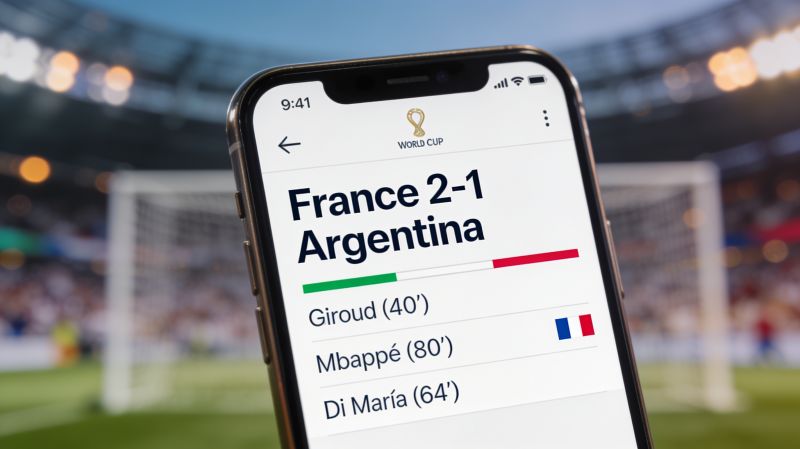
Start with the goal timeline, not the final tally. A 3-0 scoreline can hide a match that was 0-0 until the 80th minute, and a 1-1 draw can be a thriller with three disallowed goals. Accurate world cup score summary reading means scanning the minute markers for clusters. If you see goals at 45+2 and 47, that's a momentum swing—one team went into the tunnel rattled and came out shell-shocked. I keep a note on my phone during tournaments: any goal within five minutes of halftime or full time gets a star. Those are the ones that break games open. The 2022 final between Argentina and France is the extreme case—2-0 up, then 2-2。then 3-2, then 3-3—and the summary's minute-by-minute flow tells you exactly when each side lost control.Cards and substitutions tell you who ran out of ideas. A yellow card for a holding midfielder at 30 minutes usually means he's getting overrun;the summary forces you to ask why. Was the opposing winger cutting inside?Did the fullback push too high?Coaches make their first tactical sub around the 60th minute, and if the summary shows two subs before 55, someone's system failed early. England's 2018 semi-final against Croatia is a good case—Kyle Walker's early booking and a forced substitution after 70 minutes both appear in the summary, and together they explain the extra-time collapse better than any highlight reel. Don't ignore own goals or penalties either. A penalty in the 90th minute to win 1-0 reads differently than a 1-0 from a 12th-minute header. The score summary doesn't lie。but it doesn't volunteer context—you have to pull it out.
One habit that's made me a better watcher: compare the world cup score summary to the possession and shot stats. A 2-0 win with 35% possession tells you the winning side parked the bus and countered with surgical precision. A 0-0 draw with 20 shots each tells you both keepers had the game of their lives. I remember scanning the 2014 Brazil vs. Chile round-of-16 summary—1-1 after extra time, penalties 3-2—and thinking it looked tight. Then I saw Chile had 13 corners to Brazil's 2. That wasn't a tight game;that was Chile battering the door and Brazil surviving on muscle memory. The summary alone would have misled me. Pair it with one or two key stats and the story sharpens.Finally, stop treating the summary as a final product. It's a map, not the territory. After you read it。pick one line that feels off—a goal at 89', a red card at 12', a sub at 58'—and go find the 30-second clip. That habit turns a flat scoreline into a memory. I still think about the 2018 Portugal-Spain 3-3 because the summary showed a Cristiano Ronaldo free kick at 88' right after Spain had clawed back to 3-2. Without that minute marker, it's just a score. With it, you feel the air leave the stadium.