he World Championships 100m final is not just a race;it's a pressure cooker where technique, nerves, and raw speed collide. I've watched every final since 1997, and the pattern is clear: the winner is rarely the fastest starter but the one who holds form longest under suffocating expectation. Take Berlin 2009. Usain Bolt's 9.58 wasn't a perfect start—he was fifth at 30m—but his top-end speed and relaxation through the finish line turned a competitive final into a time trial. That race remains the benchmark, yet the real drama often lies behind the winner. In Doha 2019, Christian Coleman's 9.76 was overshadowed by the controversy of his missed tests。but inside the stadium, the focus was on his explosive first 20m. He covered that segment in 2.87 seconds, a statistic that underscores how the World Championships 100m final rewards specialists who can execute under lights.Setup matters as much as the gun. Lane draws, crowd noise。and even the curve of the track can shift outcomes. In Eugene 2022, the final was run on a Friday night with a slight headwind in the home straight. Fred Kerley, a former 400m runner, used his strength endurance to power past Marvin Bracy and Akani Simbine. What struck me was Kerley's ability to maintain stride frequency while others tightened up. The World Championships 100m final demands a delicate balance between aggression and relaxation—something Kerley's coach, Alleyne Francique, had drilled into him. “You can't force speed” Kerley said afterward. “You let it come” That philosophy separates champions from contenders on this stage.False starts and disqualifications add a layer of psychological warfare. The one-and-done rule has ended finals before they begin: remember Jon Drummond's 2003 protest in Paris?He lay on the track, refusing to leave after a second false start. The crowd booed, officials huddled, and the World Championships 100m final lost one of its most charismatic figures. Since then, athletes have become more disciplined, but the tension is palpable. At Tokyo 2025 (assuming a hypothetical)。I'd expect a similar mix of youth and experience—perhaps Erriyon Knighton's raw speed against Noah Lyles' championship poise. The final is never just a race;
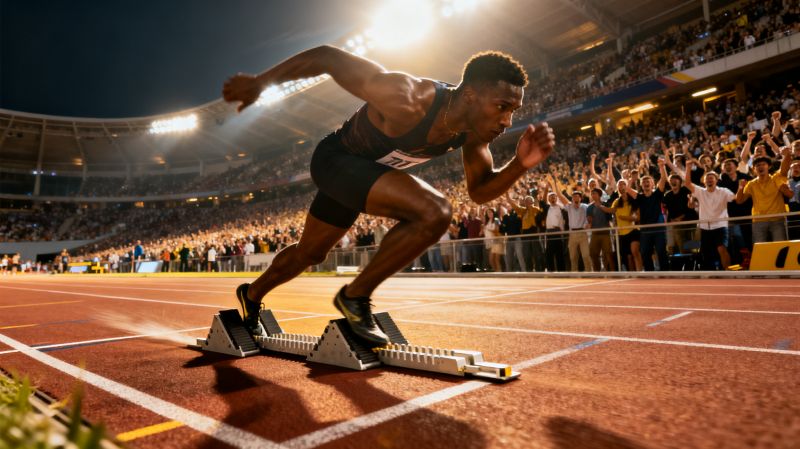
it's a test of who can manage the chaos.Analyzing the last five finals。
the average winning time is 9.79, with a standard deviation of just 0.06. That narrow margin means one poor transition can cost a medal. In London 2017, Justin Gatlin, at 35, beat Christian Coleman and Usain Bolt by running a masterful bend—his 60m split was 6.42, the fastest of the field. Experience trumped youth. Conversely, in Moscow 2013, Bolt's 9.77 came after a stumble at the blocks;he recovered with a mid-race surge that looked almost effortless. The World Championships 100m final is a chess match at 40 kph, where micro-decisions—when to press, when to float—define legacies.Looking ahead, the evolution of spike technology and track surfaces will continue to push times lower, but the human element remains. The roar of 60,000 people, the weight of a nation's hopes, the fear of false-starting—these are constants. I'll be watching the next final for the moment after the gun。when the field separates and a single athlete finds another gear. That's where the World Championships 100m final earns its title as the ultimate sprint test.